
We speak with the newly-minted St Andrew’s School Principal Luke Ritchie on nurturing the next generation, inquiry-based learning and how the school is breaking grounds in primary education.
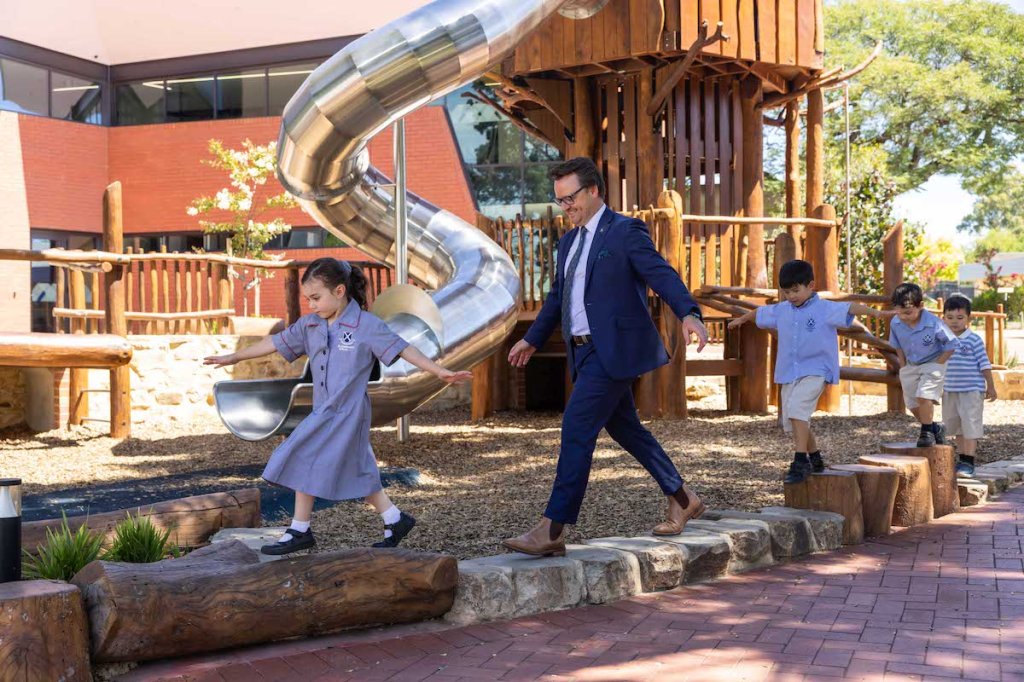
I understand you’ve spent two decades working in independent schools, predominately in SA. What skills and experience will you be bringing to St Andrew’s?
I’m very proud to be SouthAustralian through and through.I’ve got strong networks through the business community, education, government and the space sector, and I’m eager to bring those connections, along with my South Australian heritage, to my role as principal.
St Andrew’s is 100 percent invested in early-years and primary education. For me, we’re building a high-performing team to deliver the best primary school learning. We’ve just recruited a new deputy principal who’s an expert in data analysis, and we’ll use that to inform us on how children learn and to map out the personalised learning each child needs.
St Andrew’s is one of the only South Australian schools to deliver ELC –Y6 International Baccalaureate (IB) –how does this education model benefit primary-aged students?
Children are innately creative and inquisitive – and the IB uses a proven structure that enhances the curiosity children have. Instead of doing our subjects in silos, the IB allows us to explore foundational subjects in creative ways around a central idea. Around that idea, we embed numeracy, literacy, science, the creative arts and music in holistic ways. The great strength of theIB is breaking down barriers and developing an alignment between subjects and playing into children’s curious nature.
The IB program focuses on global issues – how important is it to educate primary-aged schools about sustainability and issues about climate change?
It’s critically important. So to be working with an IB program that allows children to learn deeply about the world and how to protect it, is our core business. It’s important they learn foundational skills in numeracy and literacy, but it’s equally important that they understand the world around them.
On a more local level, more than 20 SA high schools have just introduced a ban on mobile phone use during school. Is this something that you also recognise is an issue for primary students?
Technology is a wonderful tool, and I think that often gets lost in the debate around mobile phones. Any technology can be detrimental if it’s used the wrong way. At St Andrew’s, we select the best technology for our students and only when there’s a genuine purpose for it – technology shouldn’t always be the default. As a stand alone primary school, we can protect childhood innocence and promote activities we know children love, like playing, exploring and being active outside. It’s part of our duty as adults to ensure that children have every opportunity to be physical and creative and have fun without technology. It’s broader than just the mobile phone debate.
How do you hope to lead St Andrew’s students to ensure they’re future-ready and independent yet curious and collaborative?
The great thing about inquiry-based learning is that children genuinely have a voice in their learning journey. At St Andrew’s, we expect children to contribute to the learning community.It’s about identifying that children are capable now, not just when they’re adults. In turn, we ensure there are spaces where children can be curious in meaningful ways, and that they’re engaging with teachers and outside experts to develop the skills they need as learners. Our students have every opportunity to feed into discussions, debate and connect with experts in meaningful ways.
St Andrew’s School
22 Smith Street, Walkerville
08 8168 5555
standrews.sa.edu.au
@standrewsschoolwalkerville
 South Australian Style Magazine